
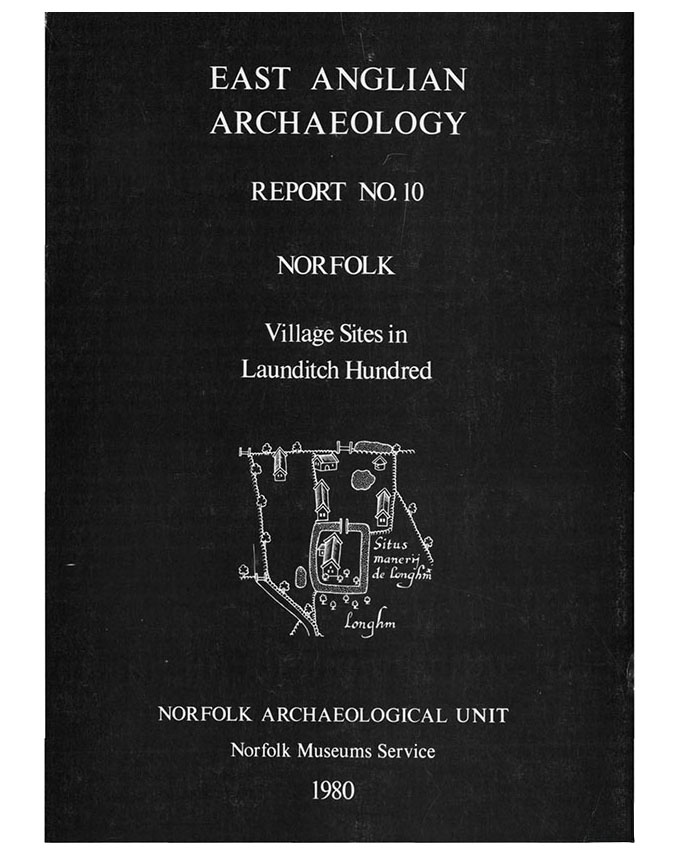
EAA 10, 1980: Fieldwork and Excavation on Village sites in Launditch Hundred
Peter Wade-Martins
Free
Download from ADS
This survey examines a relatively small area of the Norfolk countryside to discover, as far as possible, how settlement patterns have evolved from Roman, Anglo-Saxon and medieval through to recent times. The area chosen, the Launditch Hundred in west central Norfolk, contains forty-one medieval villages. Research involved a combination of detailed fieldwork around those villages where conditions were suitable, the excavation of a deserted village at Grenstein, the excavation of a Middle and Late Saxon settlement near the ruins of the pre-Conquest cathedral at North Elmham (Wade-Martins 1980, EAA 9) and a study of maps, both printed and manuscript, as well as other documentary sources. A study of three deserted village sites in the Launditch Hundred, Godwick, Pudding Norton and Bittering is published in EAA 14.
An appraisal of the four Dark Age linear earthworks in west Norfolk including the Launditch involved a re-interpretation of their plan and function (Wade-Martins 1974). The overall pattern of these monuments was considered in relation to the expansion of Anglo-Saxon settlement in Norfolk.
Full reference:
Wade-Martins, P., 1980, Fieldwork and Excavation on Village Sites in Launditch Hundred, East Anglian Archaeology 10
A4, 200pp, 90fig, 23pls
Contact us
East Anglian Archaeology is an externally-funded project hosted by Norfolk County Council, based within the Historic Environment Service.
East Anglian Archaeology, Norfolk Historic Environment Service, Norfolk County Council, County Hall, Martineau Lane, Norwich NR1 2DH
Email: EAA Managing Editor
Download books
Books older than one year are generally available for download by visiting the relevant page on this website, or direct from the Archaeology Data Service.
Order online
Books still in print are available to buy as hard copies from Script Books.