
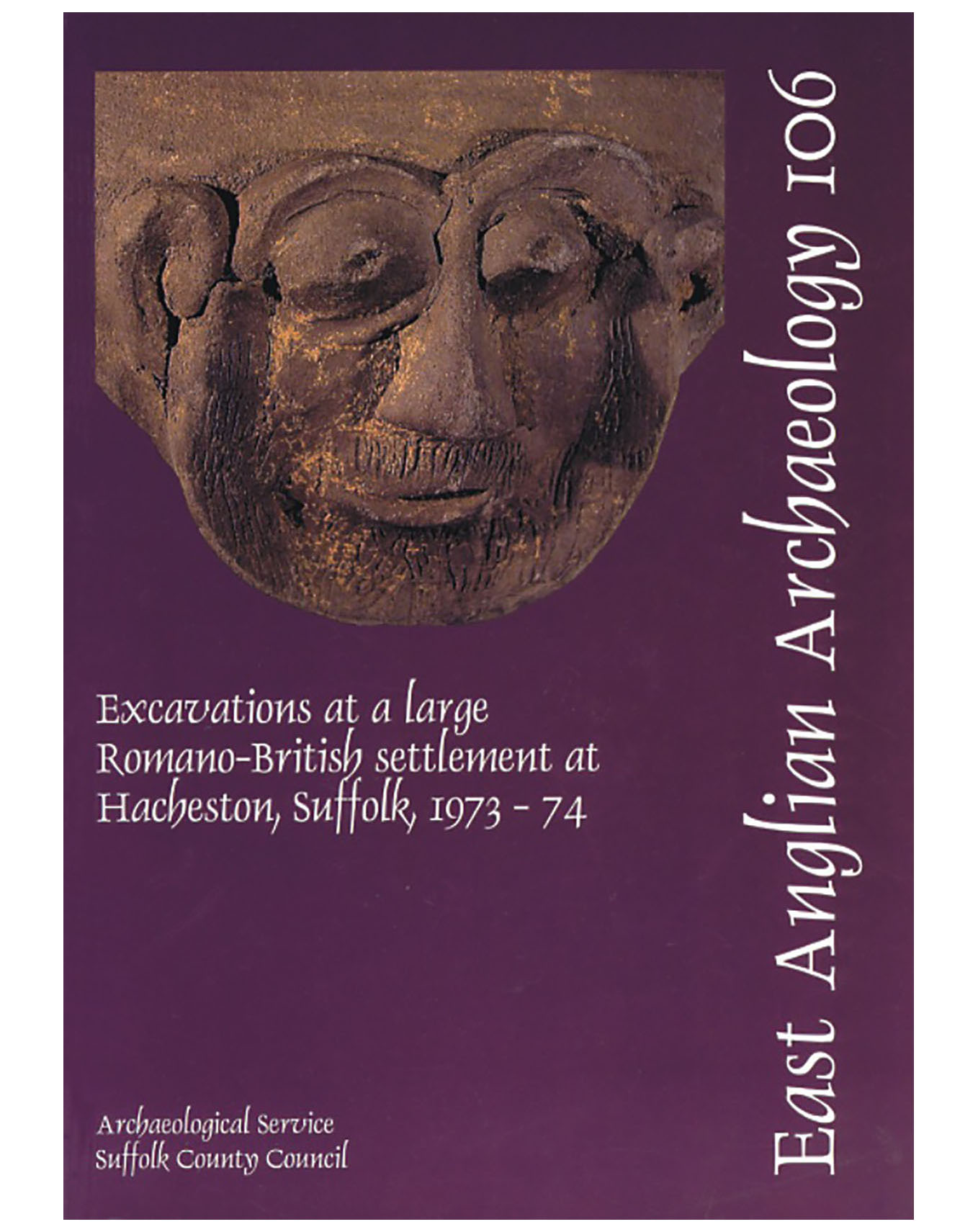
EAA 106, 2004: Excavations at a large Romano-British Settlement at Hacheston, Suffolk, 1973–4
Thomas Blagg, Judith Plouviez and Andrew Tester
£25.00£9.95
Download from ADS | Buy from Script Books
The core of this 'small town’ was established before the conquest in AD43, and seems to consist of circular buildings, enclosed by ditches and a palisade. During the later 1st century a gravel road was laid out and insubstantial rectangular buildings were erected alongside it. This basic layout continued throughout the Roman period, with a droveway and partial field enclosures to the south. Pottery was manufactured at Hacheston between the later 1st and mid 3rd centuries, and the excavations also produced iron smithing debris and related structures.
The settlement continued as a market and manufacturing centre until the 4th century, when there was a marked drop in activity, and the place had become extremely impoverished by AD370. Early Anglo-Saxon structures were found just outside the Roman settlement.
The site was one of the first on which metal detecting was carried out, and the large assemblage of metal objects adds significantly to understanding both the chronology and the status of the settlement as a market and a manufacturing centre.
Full reference:
Blagg, T., Plouviez, J. and Tester, A., 2004, Excavations at a large Romano-British Settlement at Hacheston, Suffolk, 1973–4, East Anglian Archaeology 106
A4, 220pp, 129fig, 16pls
ISBN 0 86055 278 0
Contact us
East Anglian Archaeology is an externally-funded project hosted by Norfolk County Council, based within the Historic Environment Service.
East Anglian Archaeology, Norfolk Historic Environment Service, Norfolk County Council, County Hall, Martineau Lane, Norwich NR1 2DH
Email: EAA Managing Editor
Download books
Books older than one year are generally available for download by visiting the relevant page on this website, or direct from the Archaeology Data Service.
Order online
Books still in print are available to buy as hard copies from Script Books.