
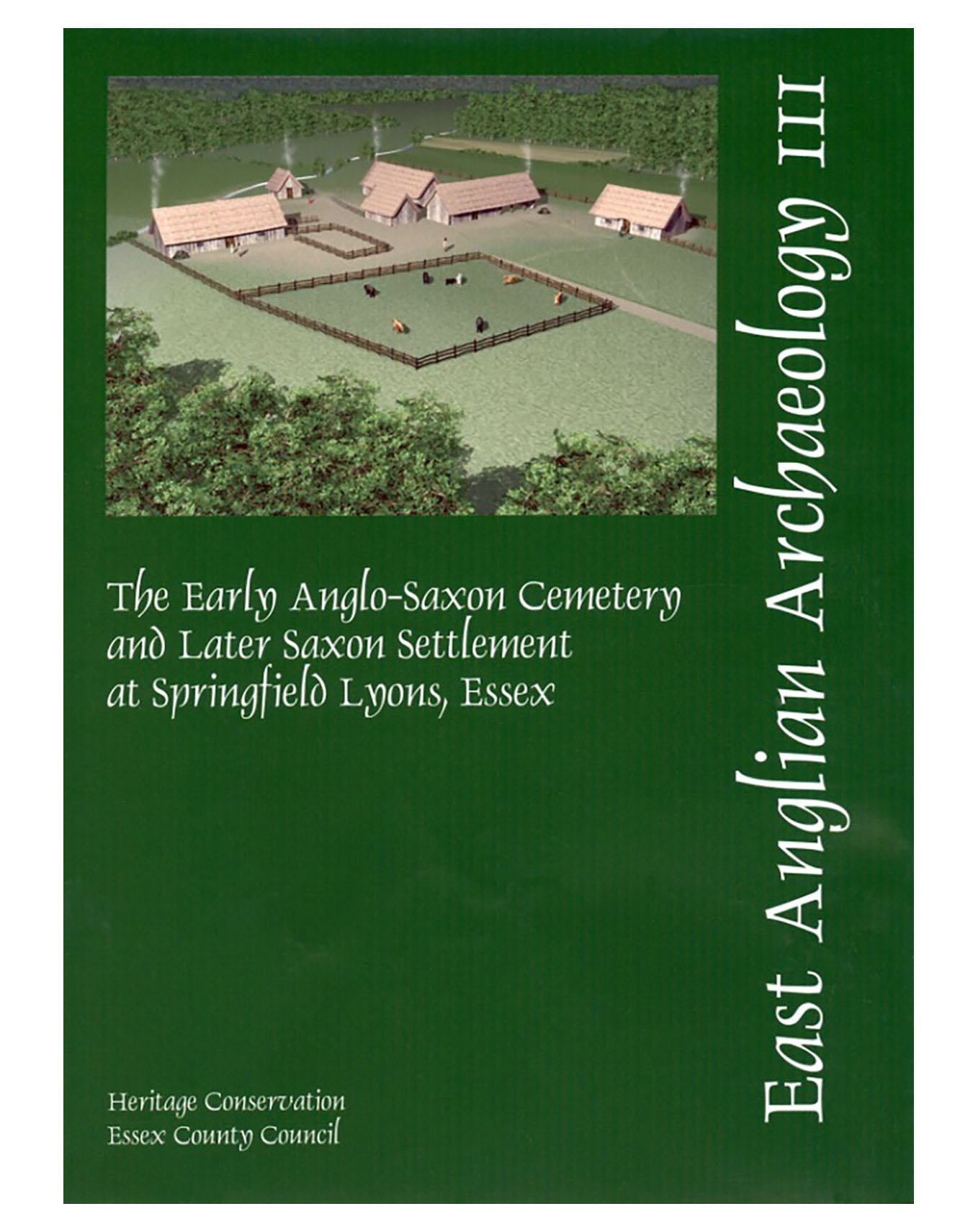
EAA 111, 2005: The Early Anglo-Saxon Cemetery and Later Saxon Settlement at Springfield Lyons, Essex
Sue Tyler and Hilary Major
Free
Download from ADS
This is the second of three reports detailing the excavations of multi-period cropmark sites at Springfield, near Chelmsford, Essex. Excavations at the primarily Neolithic cursus site at Barnes Farm were published in Proceedings of the Prehistoric Society (Buckley et al. 2001), and the excavated features and finds relating to the Saxon period at Springfield Lyons are dealt with here. The third report, which is also published in East Anglian Archaeology, discusses the Neolithic occupation and late Bronze Age settlement at Springfield Lyons (Brown 2013; EAA 149). The Saxon cemetery is superimposed on the circular Bronze Age enclosure, and may owe its location to the partial survival of the earlier monument.
The Early Saxon features comprised a mixed cremation and inhumation cemetery of over 250 burials. Approximately half of the inhumations contained grave-goods, some worn by the dead (jewellery, belt buckles), and others deposited in the grave with the body (weapons, pottery, buckets). A small number of the cremations also had artefacts (including melted beads and vessel glass) as well as very fragmented cremated bone. In the absence of good bone survival, the grave-goods and the graves themselves are the primary data source for the people buried here, the study of the artefacts indicating gender and relative status, and the study of the grave (orientation and presence, or not, of coffins and other structures) giving an insight into their religious beliefs. Some of the grave-goods are closely datable and give a date range of c. AD 450–700 for the cemetery.
Superimposed on the Early Saxon cemetery was a Late Saxon settlement comprising at least sixteen buildings and associated pits and fence lines. Finds from the settlement (including a silver penny of Aethelred ‘The Unready’) suggest a date range of c. AD 850–1200, but the bulk of the pottery dates to the 10th century, indicating that it is primarily to this century that the settlement belongs. It is likely that the site is the forerunner of Cuton Hall, listed in the Domesday Survey. Modern Cuton Hall lies less than 200m to the south.
A variety of building techniques were employed: sill-beam, post-in-trench, and posts in individual post-holes. Some of the structures may have belonged to the cemetery. The largest post-built hall, for example, appeared to fit into a large gap in the cemetery, suggesting that it could have been contemporary; however, the stratigraphical evidence to prove this is lacking. The majority of the buildings had simple agricultural functions as granaries, barns, cart sheds or animal byres. Two appear to have been more specialised: one may have been a bell tower, the other a post-mill.
Full reference:
Tyler, S. and Major, H., 2005, The Early Anglo-Saxon Cemetery and Later Saxon Settlement at Springfield Lyons, Essex, East Anglian Archaeology 111
A4, 210pp, 118fig, 13pls
ISBN 1 85281 244 3
Contact us
East Anglian Archaeology is an externally-funded project hosted by Norfolk County Council, based within the Historic Environment Service.
East Anglian Archaeology, Norfolk Historic Environment Service, Norfolk County Council, County Hall, Martineau Lane, Norwich NR1 2DH
Email: EAA Managing Editor
Download books
Books older than one year are generally available for download by visiting the relevant page on this website, or direct from the Archaeology Data Service.
Order online
Books still in print are available to buy as hard copies from Script Books.