
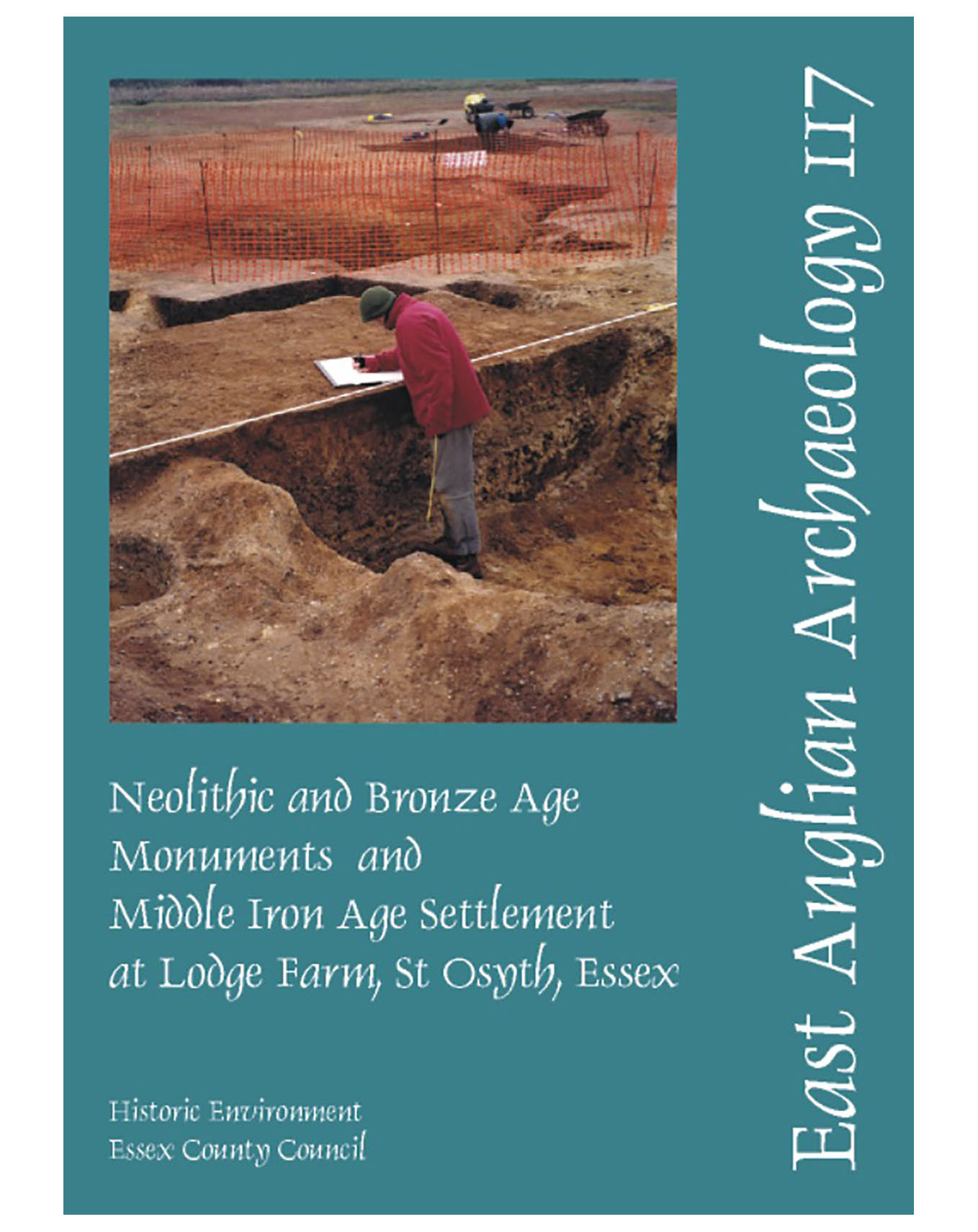
EAA 117, 2007: Neolithic and Bronze Age Monuments, Middle Iron Age Settlement at Lodge Farm, St Osyth, Essex
Mark Germany
Free
Download from ADS
A sequence of prehistoric monuments was discovered on a low spur of land in the Tendring peninsula of north-east Essex, including an Early Neolithic causewayed enclosure, an Early Bronze Age pond barrow and a Middle Bronze Age barrow group. Cropmarks indicate an Early Neolithic cursus monument to the south of the causewayed enclosure.
The causewayed enclosure was bounded by up to three lines of concentric interrupted ditches; more than 100 Early Neolithic pits lay within its interior. Large groups of worked flint and pottery occurred more frequently in the pits than in the ditches. Radiocarbon dates indicated that the pits were filled over a short period (perhaps only forty years) during the mid 4th millennium BC. Pieces of Beaker and Grooved Ware in some of the latest ditch deposits suggest that some parts of the monument were still visible during the Late Neolithic period.
The pond barrow lay within the causewayed enclosure and was a focal point for funerary and ritual activity — two cremation burials in Collared Urns, a small Collared Urn in a large pit, scorched ground and a scorched cremation burial pit indicating the site of a pyre; also two post-holes, one scorched by fire and bearing the remains of a post. Radiocarbon dates showed that the barrow had been in use in the first half of the 2nd millennium BC. Its discovery was particularly interesting because few pond barrows have been found outside Wessex and the upper Thames valley.
After a hiatus of c.200 years, the pond barrow again becomes a focal point for ritual activity. Cut into the uppermost deposit were maybe four Middle Bronze Age pits containing pottery vessels. Twenty-two ring-ditches from barrows associated with the Ardleigh Group tradition formed an arc to south and east. These were associated with small pits containing cremated bone and Bucket Urns.
Rectilinear enclosures and trackways were laid out across the site in the Middle Iron Age, and then an extensive settlement developed across the enclosures. Nineteen round-houses and sixteen or more post-built structures were recorded.
Reviewed online by Duncan Garrow for the Prehistoric Society, October 2007.
Reviewed for Essex Archaeology and History (2008) by Peter Drewett, who commends it to readers with the words ‘If you are interested in the later prehistory of Britain or the archaeology of east Essex this volume is essential reading’.
Full reference:
Germany, M., 2007, Neolithic and Bronze Age Monuments, Middle Iron Age Settlement at Lodge Farm, St Osyth, Essex, East Anglian Archaeology 117
A4, 110pp, 70fig, 11pls
ISBN 978 184194 070 0
Contact us
East Anglian Archaeology is an externally-funded project hosted by Norfolk County Council, based within the Historic Environment Service.
East Anglian Archaeology, Norfolk Historic Environment Service, Norfolk County Council, County Hall, Martineau Lane, Norwich NR1 2DH
Email: EAA Managing Editor
Download books
Books older than one year are generally available for download by visiting the relevant page on this website, or direct from the Archaeology Data Service.
Order online
Books still in print are available to buy as hard copies from Script Books.