
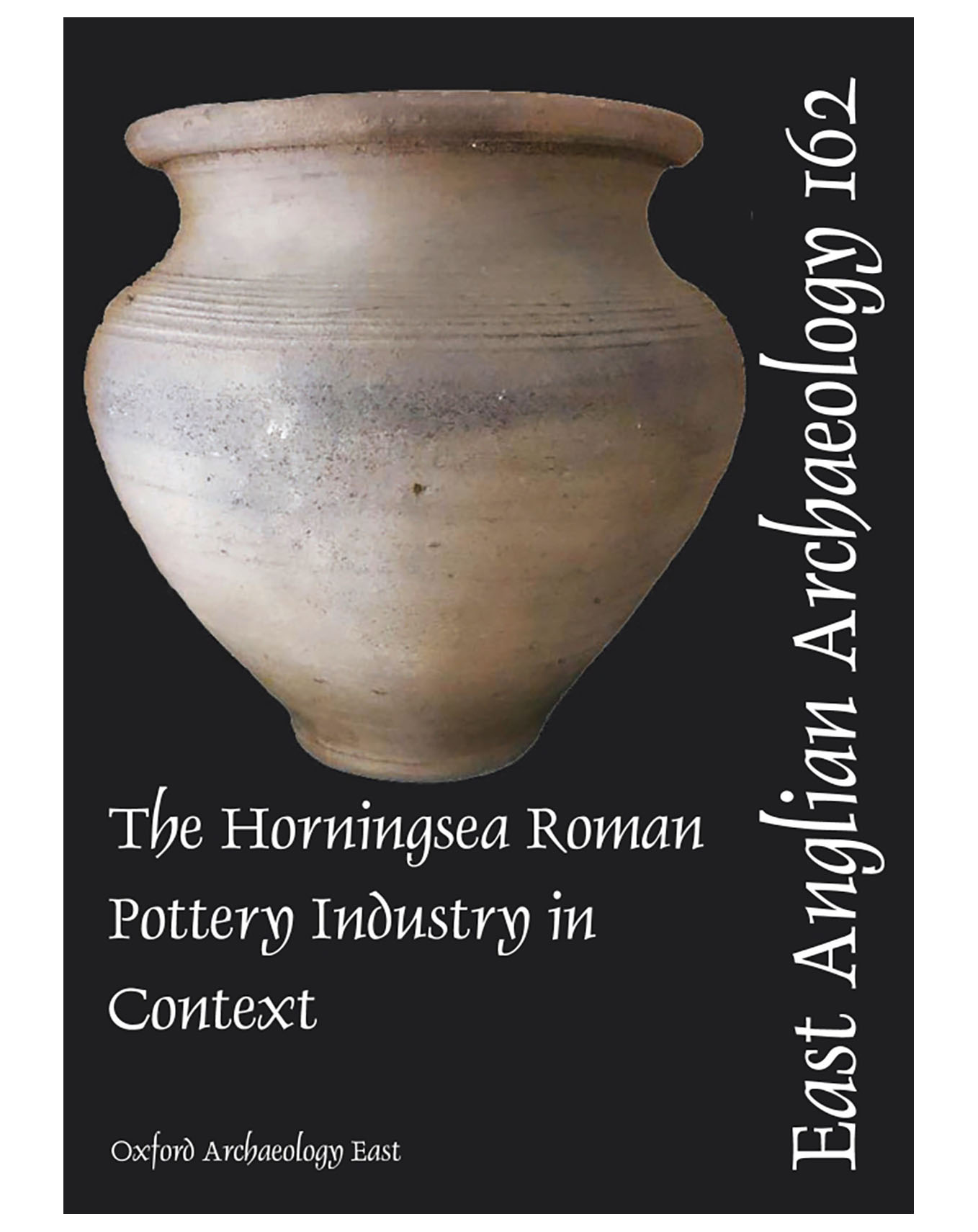
EAA 162, 2017: The Horningsea Roman Pottery Industry in Context
Jeremy Evans, Stephen Macaulay and Philip Mills
£25.00
Download from ADS | Buy from Script Books
This report provides the first complete study of the Horningsea pottery industry and a commentary on Roman pottery supply in southern Cambridgeshire. Examination of Horningsea ceramic material, including all known kiln sites, has now provided a full chronology and type series for the industry, beginning in the Flavian period (AD 60–70) and ending in the late 4th century AD (c. AD 370). The distribution network of Horningsea wares is now understood and provides an important piece of missing ceramic information for the region as a whole, and Cambridgeshire in particular. This report has also generated — for the first time — a baseline and general synthesis for Roman pottery supply in the eastern region. In addition, this study sheds light on the nature of the Roman fens and Romanisation, and on the role of the putative ‘imperial estate’ in the fenland. The project has sought to examine the relationship between the ‘urban’ ceramic supply of Roman Cambridge and its hinterland, the results of which now cast doubt on the nature of Cambridge as an urban centre per se, while identifying a new small urban site at Littleport, in the fens. Finally, this study has determined a complete chronology for the Cambridgeshire Roman canal at Waterbeach, formerly known as part of the Car Dyke: it is now clear that this did not form part of the same route as that found in Lincolnshire and that the Cambridgeshire section should henceforth be referred to by its ancient local name of Old Tillage. Analysis has confirmed that, although the dyke’s function as a canal is not disputed, Horningsea ceramics were not a significant trade item distributed along this route.
Full reference:
Evans, J., Macaulay, S. and Mills, P., 2017, The Horningsea Roman Pottery Industry in Context, East Anglian Archaeology 162
A4, 172pp plus CD
ISBN 978 1 907588 09 9
Contact us
East Anglian Archaeology is an externally-funded project hosted by Norfolk County Council, based within the Historic Environment Service.
East Anglian Archaeology, Norfolk Historic Environment Service, Norfolk County Council, County Hall, Martineau Lane, Norwich NR1 2DH
Email: EAA Managing Editor
Download books
Books older than one year are generally available for download by visiting the relevant page on this website, or direct from the Archaeology Data Service.
Order online
Books still in print are available to buy as hard copies from Script Books.