
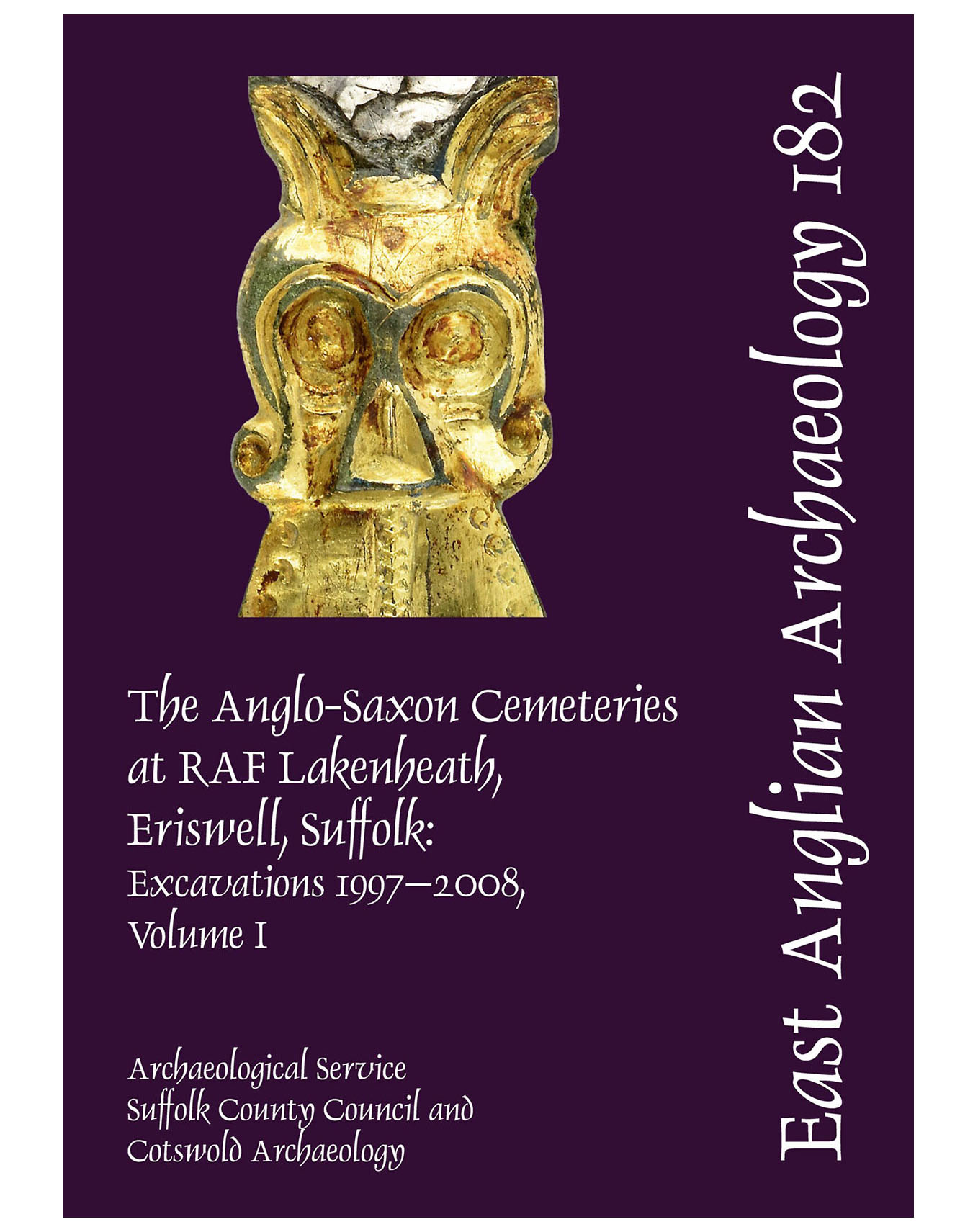
EAA 182, 2024: The Anglo-Saxon Cemeteries at RAF Lakenheath, Eriswell Parish, Suffolk (two vols)
Jo Caruth and John Hines
£75.00
Download from ADS | Buy from Script Books
In 1979, a pipe trench within the military airbase RAF Lakenheath, inside the historic parish of Eriswell in Suffolk, revealed the presence of further graves of the Early Anglo-Saxon Period at a distance of around 75m from a group of burials excavated in the late 1950s and published as the cemetery of Little Eriswell. Extensive redevelopment starting in the late 1990s led to the excavation of what appears to be a remarkable group of three discrete but contemporary burial grounds in very close proximity, here labelled the West, Central and East sites — the latter including the Little Eriswell graves. It cannot be certain that the Central and East burial grounds are fully separated, but these areas differ markedly in layout and focus and in important aspects of grave furnishing. Burial began in the West site with cremation around the middle of the 5th century. All three burial grounds were used for inhumation from the second half of the 5th to the late 6th century. For a further century, only the West site remained in use; this site was abandoned in the late 7th century when burial commenced at a ‘Middle Anglo-Saxon’ cemetery 300m to the south at Lord’s Walk. By the late 6th century the size of the burying population had apparently fallen by as much as 80%, from a hundred or more to maybe only 20.
The quality of the archaeological evidence allows for detailed examination and reconstruction of burial practice in terms of the structure of the graves and how the bodies were laid in them. Soil conditions create some variance in skeletal preservation, but generally good survival reveals a naturally structured community and allows for observation of its pathologies. Isotope and pioneering aDNA analyses identify an essentially local population but with one strong contender for an early, 5th-century, immigrant from across the North Sea, and indeed for cross-generational descent within the community. The grave goods illustrate social differentiation, primarily by sex and age although exceptionally richly furnished and elaborately constructed graves such as the horse and ‘warrior’ burial embody additional status differentials. A series of expert scientific analyses have been targeted at revealing how this community made use of the principal material resources available to it; how it could live and function in this topographical niche at this period. It is clearly demonstrated that there is a very solid foundation in all of the evidence from this site for continuing specialised research, not least as new techniques of analysis and research perspectives develop.
EAA 182 is a two-volume report: Volume I The Excavation, Volume II The Grave Catalogue (bound in two parts - catalogue and illustrations).
Full reference:
Caruth, J. and Hines, J., 2024, The Anglo-Saxon Cemeteries at RAF Lakenheath, Eriswell Parish, Suffolk, East Anglian Archaeology 182
A4, 2 vols, 1100pp
ISBN 978 0 9568747 8 8
Contact us
East Anglian Archaeology is an externally-funded project hosted by Norfolk County Council, based within the Historic Environment Service.
East Anglian Archaeology, Norfolk Historic Environment Service, Norfolk County Council, County Hall, Martineau Lane, Norwich NR1 2DH
Email: EAA Managing Editor
Download books
Books older than one year are generally available for download by visiting the relevant page on this website, or direct from the Archaeology Data Service.
Order online
Books still in print are available to buy as hard copies from Script Books.