
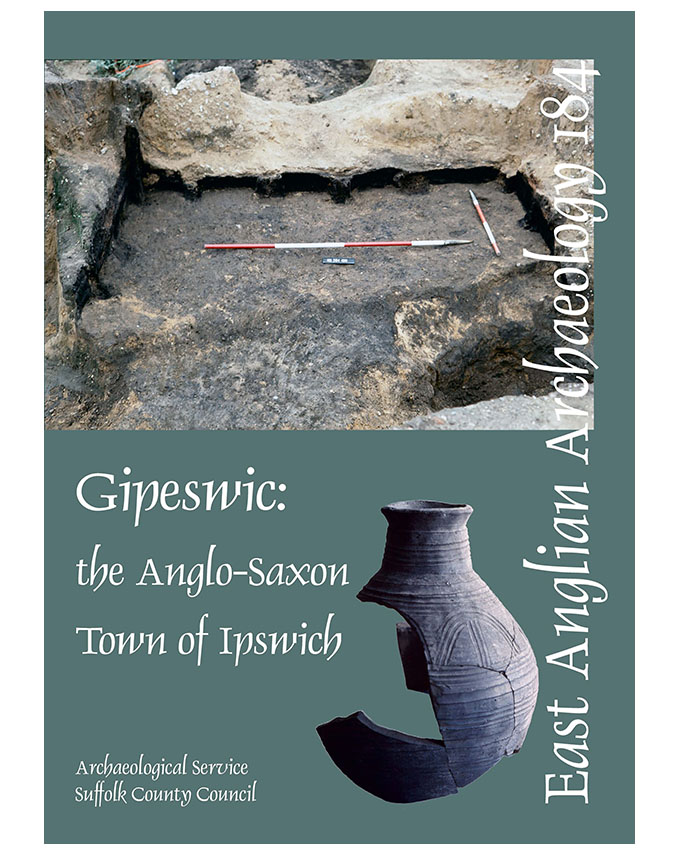
EAA 184, 2025: Gipeswic: the Anglo-Saxon Town of Ipswich
Keith Wade
£35.00
Download from ADS | Buy from Script Books
The modern town centre of Ipswich lies on the site of its Anglo-Saxon predecessors. The earliest excavations and observations were made by Miss Nina Layard in the late 19th and early 20th centuries (Layard 1898, 1900, 1907). Pottery and artefacts recovered over the past two centuries from within the historic core of the town have been collected by the Borough Museum since it was established in 1846.
Investigation of the Museum’s collections by John Hurst and Stanley West in the late 1950s (Hurst and West 1957) allowed them to identify pottery made in the town (Ipswich ware) and date it to the Middle Saxon period (c.650–c.850 AD). They also concluded that it was being produced in quantity and being traded over much of eastern England during that period.
West carried out the first government sponsored archaeological excavations in 1958 and 1959, which recorded the first stratified groups of Middle Saxon and later finds, including imported pottery (West 1964). West used the museum collections to plot the find-spots of Ipswich ware in the town revealing a large area of Middle Saxon occupation underlying much of the present town centre.
Despite the establishment of the town’s early foundation and likely importance, the opportunity was not taken to undertake further archaeological excavation in the 1960s and early 1970s, despite a rash of development. Following the establishment of the Suffolk Archaeological Unit in 1974, Keith Wade initiated the ‘Origins and Development of Ipswich Project’ and, between 1974 and 1990, 36 archaeological excavations were undertaken.
This volume represents the first summary publication of the stratigraphic evidence for the Anglo-Saxon deposits encountered on these sites plus some newly commissioned specialist reports on the non-ferrous metal objects, glass and Anglo-Saxon coins. A full archive of all the site and finds records was published in 2020 on the Archaeology Data Service website. This includes detailed reports on the pottery and human remains. Other aspects have already been fully published such as the animal bones, bone and antler objects and the 7th-century cemetery found at the St Stephen’s Lane/Buttermarket sites. Since 1990, there have been over 20 developer-funded excavations and significant results from these are referred to in this volume.
The excavations showed that the origins of the town, on its present site, lie in the 7th century with a number of cemeteries surrounding an area of some 10 hectares of occasional occupation, probably by Frankish traders and largely using tents. The lack of coinage of this date, in comparison with other sites such as Rendlesham and Coddenham, implies that exchange took place at those sites and not in Ipswich.
This all changes in the early 8th century when a town is laid out on the higher ground with an economy based on international trade and craft production, most notably the production of Ipswich ware which was supplied over all of eastern England and beyond. In the later 9th century, following the Danish invasion and settlement, the economy of the town revives with abundant evidence for metalworking and a change of pottery production to Thetford-type ware. This represents a distinctive change in material culture including building types. The town was also defended for the first time with a bank and ditch. Over a hundred Anglo-Saxon buildings were recorded changing from surface-laid buildings in the Middle Saxon period to sunken-featured buildings in the Danish and later Saxon period, returning to surface-laid buildings in the 12th century.
The Norman Conquest was followed by the devastation of the town between 1066 and 1086, the construction of a castle and its destruction in the 12th century.
Full reference:
Wade, K., 2025, Gipeswic: the Anglo-Saxon Town of Ipswich, East Anglian Archaeology 184
A4, 360pp
ISBN 13 978 0 9568747 9 5
Contact us
East Anglian Archaeology is an externally-funded project hosted by Norfolk County Council, based within the Historic Environment Service.
East Anglian Archaeology, Norfolk Historic Environment Service, Norfolk County Council, County Hall, Martineau Lane, Norwich NR1 2DH
Email: EAA Managing Editor
Download books
Books older than one year are generally available for download by visiting the relevant page on this website, or direct from the Archaeology Data Service.
Order online
Books still in print are available to buy as hard copies from Script Books.